Home Birth – What Should You Consider and Which Questions Should You Ask Yourself?
Congratulations, you are expecting a child! Maybe you have been longing for a pregnancy for a long time and have already immersed yourself in all the topics surrounding the upcoming months during the “waiting period.” But it could also be that you are still quite surprised and need some time to get used to the idea. A few decisions have to be made right at the beginning of pregnancy, even though they concern the end — the birth itself. One of these decisions is about the place where you would like to give birth to your baby.
Planning a Home Birth
For many expectant mothers, the place of birth is quite clear: they want to give birth in a hospital. Which hospital it will be can be decided calmly over the course of the pregnancy. Some women, however, wish to give birth not in a clinic, but within their own four walls.
Because there are relatively few midwives in Germany who attend home births, you should start looking for your home birth midwife as soon as you have a positive pregnancy test in your hand. Depending on your region, this may even be before your first doctor’s appointment.
At this point, you may not know exactly what a home birth means for you and your child. Let us shed some light on it.
Start looking in good time for a midwife who can support you during your home birth.
How Does a Home Birth Actually Work?
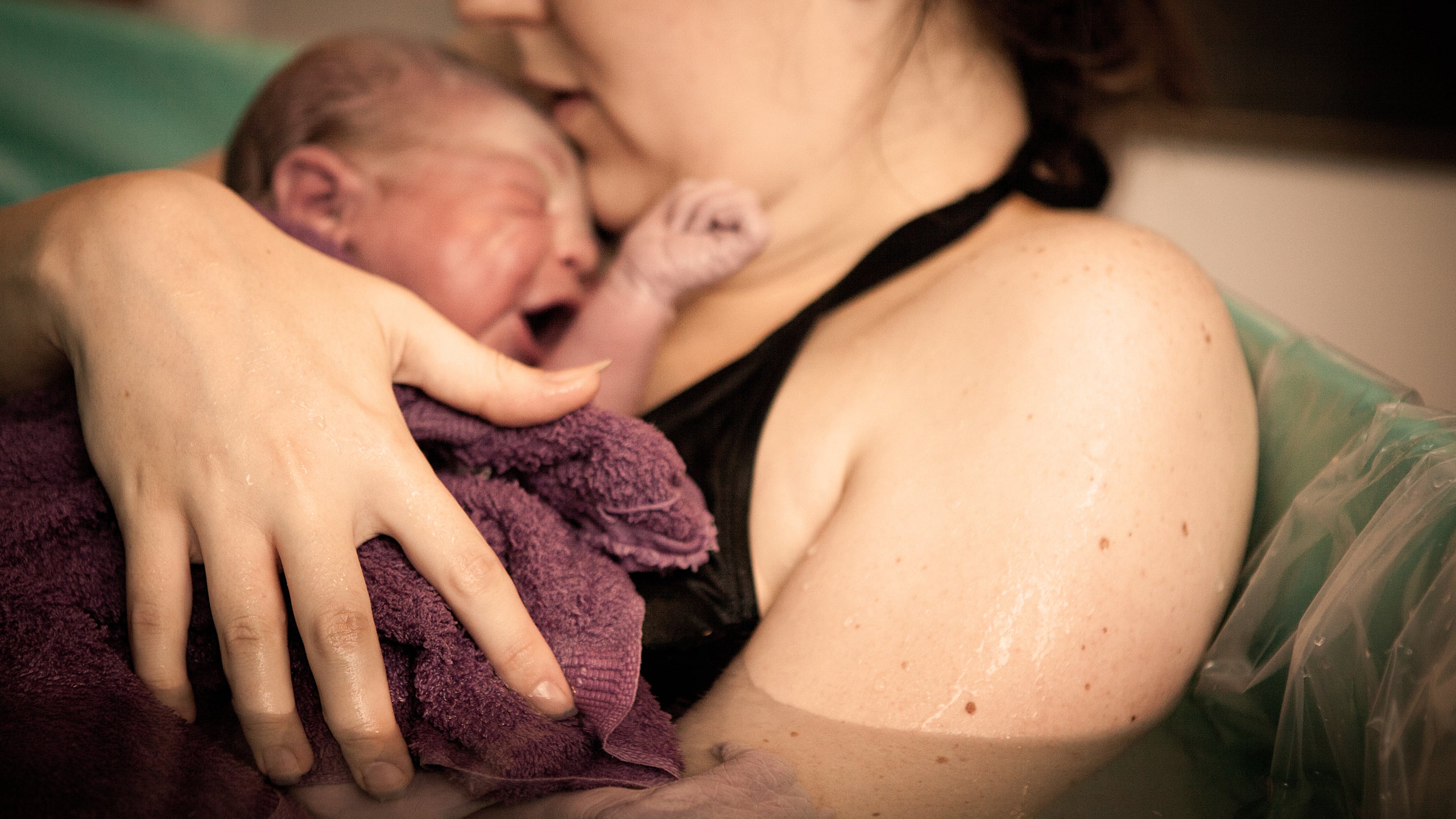
During a home birth, a healthy pregnant woman who is expecting a healthy baby is cared for by her midwife, whom she already knows from prenatal appointments. The birth takes place in your own home, so you do not have to decide when to leave, or worry about possibly being sent home again.
You stay in close contact with your home birth midwife, and as soon as you need support, she sets off with all the equipment she needs.
Once she arrives, she will first observe you for a little while:
- How are you coping during contractions?
- Do you need support with the right position or breathing?
- Are you able to recover well during the pauses?
Afterwards, she will examine you and your baby. She may ask whether she can check your cervix and amniotic sac by palpation in order to assess more accurately which stage of labour you are in. After a contraction, she will also listen to your baby’s heartbeat to make sure that your baby is recovering well from the contractions too.
The Moment Has Arrived
Once you and your midwife assume that the baby will be born soon, all the equipment your midwife may need for the birth is placed ready. After some time, the moment arrives and your baby is born — peacefully and safely.
- In your own bathtub
- in the living room
- or in the bedroom.
Wherever and however you feel most comfortable.
After your midwife has examined you and your newborn, after your baby has had their first feed, and once everything has been documented and tidied away, she will quietly leave after around 2–4 hours until the first home visit during the postpartum period.
Sounds good? It is.
What If Something Does Not Go Ideally during Pregnancy, Birth or the First Few Minutes?
To ensure that mother and child are well in the end, there are many safety nets. After the first contact with your midwife, you get to know each other and have an initial consultation. She will ask you many questions about your health and how your pregnancy has progressed so far. She will also explain exactly how she works.
- Does she perhaps have a colleague who can provide support during the “hot phase” of labour?
- She will explain to you and your birth companion exactly in which cases a home birth cannot be planned from the outset.
There is even a specific catalogue of criteria from the health insurance funds designed to avoid risky situations.
Are You Expecting Twins?
If you are expecting twins or have problems with blood clotting, you are better cared for in a hospital. At the end of the article, you will find a link to the “exclusion criteria of the statutory health insurance funds”.
Prenatal Check-Ups Are Important
Sometimes such a situation only becomes apparent during the course of the pregnancy. Your midwife will recognize this during a prenatal check-up and will then be able to advise you on the ideal place to give birth. Thanks to this careful preparation, dramatic situations during labour can almost always be avoided.
Sometimes unexpected problems occur during birth. However, your midwife always has emergency techniques and emergency medication with her so that she can intervene immediately and defuse or stabilize the situation until you are transferred to a hospital. To ensure that such a transfer does not have to happen as an emergency, your midwife will repeatedly check during labour whether you and your baby are doing well during contractions and, at the slightest doubt, discuss the next steps together with you.
Often, however, the reason for going from home to the hospital is not an emergency at all. It may simply be that, with your first baby, you imagined contractions very differently and, now having experienced some of them yourself, you would like stronger pain relief. Changing your mind at short notice is completely fine. By planning a home birth, you are not entering into an obligation towards yourself or your midwife. We all want you to remember your birth positively — whether we are home birth midwives or hospital midwives.
Is “Home” the Ideal Place to Give Birth?
Every woman and every family may decide this entirely for themselves. Discussions about this topic are often highly emotional. To assess how safe the individual birthplaces are, all births in Germany are statistically evaluated. These data show that healthy women without risk factors are very well cared for by our well-trained home birth midwives.
I hope the following information will make your decision a little easier.
Do You Feel Your Home Is the Perfect Place to Give Birth?
Then our tips can help you prepare for your birth:
Finding a Midwife
At the latest, once you have your maternity record in your hands, you should contact a home birth midwife. You can find all midwives who work with statutory health insurance in the relevant list.
You may need to set your search radius a little wider. If there is no home birth midwife living in your immediate area, try entering 50 kilometres in the search field.
Hospital Registration
Even if you would prefer to welcome your baby at home, I recommend registering at the nearest hospital. If an urgent transfer becomes necessary during or after the birth, your data, your blood group and your week of pregnancy will already be known, and you will not lose valuable time with a lengthy medical history.
Costs
The costs of the birth, support during labour and your baby’s first examination are paid directly by the health insurance provider. However, midwives remain available for you day and night for up to five weeks. For this service, known as on-call availability, a fee of between 500 and 1,000 euros is charged depending on the midwife and region.
That may sound like a lot of money at first, but your midwife greatly limits her private life during this time. Neither a cocktail evening with friends nor a spontaneous short holiday is possible during these weeks. Some insurance companies cover part of these costs on request, so it is worth asking.
Paperwork
Just like after a hospital birth, every child born in Germany must be registered with the registry office. You will receive a form from your town or city and can then fill it out together with your midwife, who witnessed the birth. With this birth registration, you also determine your baby’s name. But do not worry if you do not want to decide before the birth. You have one week to register the birth with your local authority.
You can find out what you need to bring in addition to the “birth notification” from your local authority, for example.
Practical Preparation for Your Home
As your birth window approaches, you can prepare everything for the birth, the first few days and also for the possibility of a transfer to hospital.
Checklist: Final Preparations
- Bag with important documents: maternity record, insurance card, important medical documents, mobile phone + charger
- Hospital bag: cosmetics, medication, comfortable clothes, towels and one set of clothes to take your baby home in
- Box with everything needed for the birth: towels, glucose tablets, snacks and drinks, loose underwear, thick maternity pads, fitted sheets + protective film, disposable pads, birth pool or paddling pool, baby blanket, little hat, muslin cloth, camera
About the Editorial Team
Töpfer Editorial Team
 Specialist editorial team at Töpfer
The specialist editorial team of Töpfer Babywelt provides you with carefully reviewed information, midwifery knowledge and current scientific insights on pregnancy, birth, the postpartum period and infant care. toepfer-babywelt.de
Frequently Asked Questions
-
Classification of the Current Situation Show Hide
1. What are the current recalls about?
In recent weeks, media outlets have reported on recalls of infant formula products from certain international manufacturers. According to publicly available information, the heat-stable toxin cereulide was associated with a specific issue during the fermentation of a raw material at the supplier level.
2. Is Töpfer affected by these recalls?
No. Our products are not affected. Our supply chains are independent of the publicly mentioned problematic supply chains. Safety and control are our top priorities from the very beginning.
3. Has the safety of Töpfer products been reviewed?
Töpfer products are subject to a multi-stage, strict control and verification process throughout the entire value chain. This process is an integral part of our quality promise and ensures the special Töpfer quality.
In addition, Töpfer is monitored by the competent Bavarian food control authority. Our products and processes are regularly inspected by authorities.
In connection with the current recalls, the responsible Bavarian Authority for Food Safety and Veterinary Affairs reviewed our supplier declarations, analytical data, and our testing and release procedures. The requested documentation was accepted.
Based on our comprehensive testing and control systems, Töpfer products are not affected and can be used without restriction. -
Cause of the Recalls – Technical Classification Show Hide
1. What exactly is cereulide?
Cereulide is a heat-stable toxin.
Cereulide is a heat-stable toxin. This means: once it has been formed, it cannot be destroyed by normal heating.
2. When does cereulide form?
Cereulide does not automatically form due to the presence of the bacterium itself. It only develops under very specific conditions, especially:
✓ certain temperature ranges
✓ sufficient moisture
✓ suitable nutrient conditions
✓ extended growth time
Typically, this occurs in improperly stored starchy foods or, as discussed in the current case, under specific fermentation conditions of a raw material.
3. Does cereulide form in dry infant formula?
No. Dry infant formula does not provide the conditions required for cereulide formation. The toxin can only develop if it has already been formed previously under moist conditions.
4. Why is cereulide relevant?
In higher amounts, cereulide can cause nausea and vomiting. For this reason, raw materials are strictly controlled before being used in food products. -
Production and Independence Show Hide
1. Does Töpfer produce together with other brands?
No. Töpfer manufactures exclusively at its own production facility in the Allgäu region of Germany. We do not share production lines or facilities with other manufacturers. This independence is a central component of our quality strategy.
2.Are there overlaps in the supply chain with affected brands?
No. Our regulatory reviews and supplier audits show no connections to the publicly mentioned problematic supply chains. Each raw material at Töpfer is independently qualified, tested, and approved, regardless of the supply chains used by other manufacturers.
3. Where do Töpfer’s raw materials come from?
Our focus is on organic quality as well as regional and European sourcing. The majority of our raw materials originate from the Allgäu region, from Germany, or from Europe. This proximity ensures quality, transparency, and traceability.
4. Are raw materials from outside the EU used?
Certain raw materials are unfortunately only available in limited quantities worldwide. Even if such raw materials are used occasionally, our strict EU-based quality and control standards apply without exception. Procurement is carried out exclusively through qualified, long-standing, and continuously audited partners within the DACH region.
5. Has Töpfer sourced raw materials from Cabio Biotech?
No. Töpfer has never sourced raw materials from Cabio Biotech for its production. -
Quality Assurance Show Hide
1. How does Töpfer ensure the quality of its raw materials?
At Töpfer, quality begins with the raw materials. We work exclusively with long-standing qualified partners based on clearly defined specifications. Each relevant batch is tested before being used.
2. Are microbiological tests conducted?
Yes. Both raw materials and intermediate and finished products are comprehensively tested microbiologically, in our own laboratories and additionally by external accredited institutes.
3. Are chemical and contaminant analyses conducted?
Yes. Our quality control includes comprehensive chemical testing in accordance with legal requirements and internal quality standards.
4. Is there a release procedure before products are placed on the market?
Yes. No product leaves our facility without a complete quality inspection and formal release.
5. Have testing procedures been adjusted to new limit values?
Yes. Our analytical procedures have been aligned with updated scientific evaluation standards. New limit values do not indicate new risks but rather provide additional safety.
6. Have there been any recalls of Töpfer products in recent years?
No. In recent years, there have been no recalls or official quality warnings due to contamination or non-compliant ingredients.
Disclaimer
The content provided on this website is intended solely for general informational purposes on topics related to pregnancy, parenthood, infant and child nutrition, and early childhood development. It has been prepared with the utmost care and in collaboration with qualified professionals.
The content does not constitute individual medical, nutritional, or other professional advice in specific cases and cannot replace personal consultation and care by qualified professionals in medicine, pharmacy, and nutrition. For any health-related questions, concerns, or uncertainties, please always consult an appropriately qualified professional.
Where this website provides information about products, their use, or possible properties, this constitutes general information only. Individual results may vary.
Use of the content provided on this website is at your own responsibility. Töpfer GmbH's liability for decisions, actions, or damages resulting directly or indirectly from the use of the content is excluded to the extent permitted by law.
Töpfer GmbH assumes no responsibility for the content of external websites linked from this site. The operators of the linked pages are solely responsible for their content.